Somewhere in most people’s mental medicine cabinet is a warning that showed up from a doctor, a pharmacist, or a friend who once got sick and blamed it on this: don’t wash your antibiotics down with a glass of milk. Nobody ever explains exactly why — only that milk and antibiotics don’t mix. Is that true of antibiotics as a whole, or does it apply to a narrow slice of them?
Look at a prescription bottle in the US or UK and the instructions differ drug to drug: “take on an empty stomach,” “take with food,” “may be taken without regard to meals.” In South Korea, pharmacies tend to collapse all of that into one instruction printed on every dispensing envelope, regardless of what the drug actually is: three times a day, 30 minutes after meals. Is 30 minutes really the number that matters — and if it is, is it the after-meal window, or is the real deadline somewhere else entirely?

This post is a fact-check for entertainment, not legal, tax, or medical advice. Consult a qualified professional before acting on any of it.
QUESTION
What’s actually behind instructions like “take with food” or “take on an empty stomach”? Is there a drug for which “30 minutes” is a genuine pharmacological cutoff — and if so, does that strict window belong to the after-meal side of the clock, or the before-meal side?
The milk question needs the same kind of narrowing. If milk really does interfere with certain drugs, which ingredient in it is reacting with which drug, and through what mechanism? Is this a problem with antibiotics as a category, or with one or two specific families inside that category?
CHECK
US drug labels don’t lump everything together
Blanket instructions like “30 minutes after meals” are actually unusual. DailyMed, the U.S. National Library of Medicine’s database of FDA-approved drug labeling, lists a specific, drug-by-drug timing recommendation tied to each medication’s own absorption profile. The label for the antibiotic cephalexin, for instance, states plainly that it “may be given without regard to meals.”[1] Other drugs, as we’ll see, go the opposite direction and specify a window as tight as “30 minutes to an hour before eating.” Unlike a catch-all “30 minutes after meals,” those numbers are derived directly from how the drug is actually absorbed.
The twist: the real “30 minutes” belongs to drugs taken before meals
This is where the common assumption gets flipped. People tend to associate the number “30 minutes” with taking medicine after a meal. But the drugs where 30 minutes is enforced down to the minute are, overwhelmingly, drugs taken before meals.
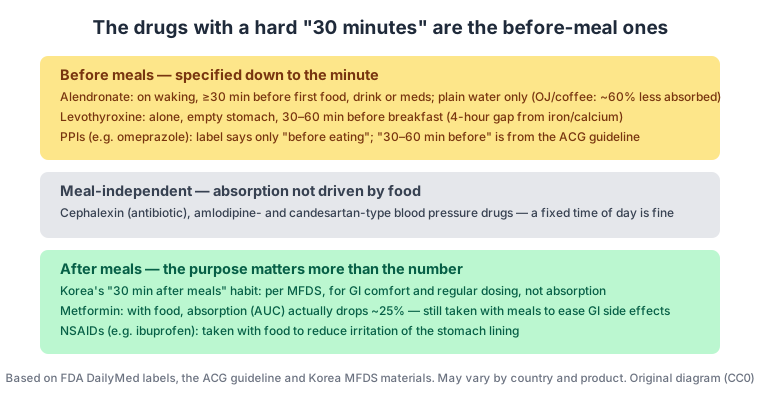
The osteoporosis drug alendronate is the clearest case. Its FDA label instructs patients to swallow it first thing after waking, with 6–8 fl oz (180–240 mL) of plain water, at least 30 minutes before the day’s first food, beverage, or other medication.[2] That specificity isn’t arbitrary — clinical trials found that even orange juice or coffee alone, with nothing else, sharply cut absorption, so the label bars anything but plain water. The same label reports that taking alendronate with coffee or orange juice reduced bioavailability — the fraction of the drug that actually makes it into the bloodstream — by roughly 60%.[2] It also warns patients to stay upright for 30 minutes after dosing, a separate precaution aimed at preventing the pill from irritating the esophagus, not an absorption issue.[2]
Levothyroxine, used to treat hypothyroidism, follows the same logic. Its FDA label instructs patients to take it alone, on an empty stomach, “one-half to one hour before breakfast.”[3] The same label requires at least a 4-hour gap from iron, calcium supplements, or antacids — all of which interfere with absorption.[3]
Omeprazole, a proton pump inhibitor (PPI) used for acid reflux, is also meant to be taken before eating — but the source of the “before meals” instruction is worth separating from the source of “how many minutes.” The DailyMed label itself only says “before eating,” with no specific number of minutes attached.[4] The precise “30 to 60 minutes before” figure actually comes from the American College of Gastroenterology’s (ACG) clinical practice guideline for gastroesophageal reflux disease (GERD). That guideline gives a strong recommendation to take a once-daily PPI 30–60 minutes before the first meal of the day, or, for twice-daily dosing, 30–60 minutes before both breakfast and dinner.[5] In other words: the label supplies the principle (“take before eating”), and a clinical guideline — not the label — supplies the number.
All three cases share the same underlying reason: absorption mechanics. Alendronate is already absorbed at under 1% even under ideal conditions, and even a small amount of food in the stomach wipes out most of that already-tiny fraction.[2] Levothyroxine needs to dissolve in an empty, acidic stomach to be absorbed, and food — or the calcium and iron in other pills — gets in the way.[3] PPIs only work while the stomach’s acid-producing “proton pumps” are active, and those pumps are switched on hardest by the act of eating; the drug has to already be in place before that happens in order to block the acid a meal is about to trigger.[5]
Korea’s “30 minutes after meals” — not actually about absorption
So where does the familiar catch-all instruction come from, and what is it actually protecting? South Korea’s Ministry of Food and Drug Safety (MFDS) addressed this directly in an official explainer published through its imported food and drug information portal. The agency states that the “three times a day, 30 minutes after meals” instruction exists “to reduce gastrointestinal side effects caused by medication, while also helping patients take their medicine regularly, in sync with mealtimes, so that a consistent drug concentration is maintained in the body.”[6] Yaksa Gongnon, a Korean pharmacist trade publication, reported a similar explanation citing the MFDS’s own drug safety evaluation institute.[7]
It’s worth reading that “maintains a consistent concentration” language carefully — it does not mean absorption peaks precisely at the 30-minute mark. Read in context, the “consistent concentration” is a product of dosing at regular intervals, not of hitting 30 minutes specifically. The instruction serves two purposes: reducing stomach irritation from drugs that are hard on an empty stomach (NSAIDs like ibuprofen and diclofenac, iron supplements), and piggybacking medication onto the built-in rhythm of three daily meals so patients don’t forget a dose.[6] The MFDS material is explicit that patients may take a drug at its scheduled time even if they skip a meal, as long as the drug doesn’t cause GI irritation.[6] A Yaksa Gongnon contributor, a practicing pharmacist, made essentially the same point: “since taking it on an empty stomach doesn’t meaningfully change the drug’s effect, mentioning the risk of stomach upset is enough.”[8] Both the government agency and pharmacists on the ground are, in other words, acknowledging that “30 minutes after meals” is not a universal absorption rule.
The MFDS material even spells out specific exceptions: blood pressure medications such as amlodipine and candesartan, whose absorption isn’t affected by food, can be taken at a fixed time regardless of meals.[6] More recently, some voices within Korea’s pharmacy profession have pushed to reconsider the convention altogether. Yaksa Gongnon reported that “30 minutes after meals” originated as a way to fit dosing into Koreans’ habitually regular three-meal pattern and improve adherence — but for patients who skip meals often, the same rule can cause them to miss doses instead. The article floated interval- or frequency-based alternatives, like “every 5 hours” or “twice a day,” in place of meal-anchored timing.[8] What this reporting could not establish — and what this fact-check did not find any primary documentation of — is exactly when or how the “30 minutes after meals” convention took hold in Korean clinical practice in the first place. Why it has persisted is well documented; when and how it started is not. Rather than guess at an origin no source confirms, this piece treats only “why it persists” as established fact.
The control group: when after-meal timing really does matter, and metformin’s paradox
There are drugs where taking them after meals genuinely helps. Nonsteroidal anti-inflammatory drugs (NSAIDs) like ibuprofen irritate the stomach lining, and food in the stomach cushions that irritation.[6] So far, this matches the common assumption.
The more interesting case is metformin, the widely used diabetes drug (brand name Glucophage, among others). Food-effect data on the FDA label show that when an 850 mg tablet is taken with a meal instead of on an empty stomach, peak blood concentration (Cmax) drops by about 40%, total absorption as measured by the area-under-the-curve (AUC) drops by about 25%, and the time to reach peak concentration (Tmax) is delayed by 35 minutes.[9] In plain terms: taking metformin after a meal reduces how much of the drug actually gets absorbed. And yet metformin is still recommended to be taken with food. The reason is simple — food eases the nausea and diarrhea that are metformin’s most common side effects, so a patient is more likely to keep taking the drug consistently even if slightly less of each dose is absorbed. It’s the exact opposite of the intuitive idea that “after meals” automatically means “better absorbed.”
The milk problem: a couple of specific drug classes, not antibiotics in general
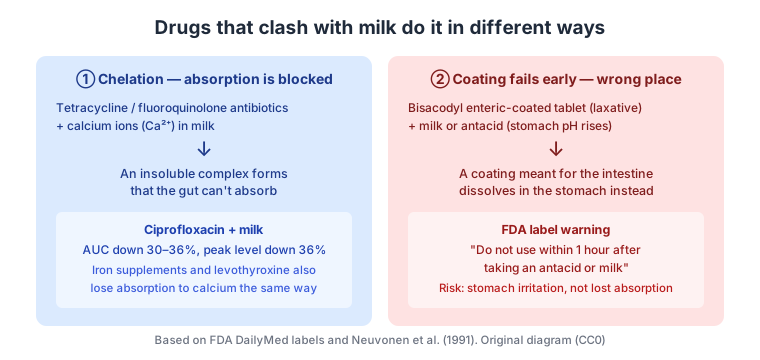
Now to milk. The drugs that actually clash with it aren’t antibiotics broadly — they’re two specific families: tetracyclines, and fluoroquinolones (ciprofloxacin and similar drugs). The mechanism is chelation: these drugs’ molecular structure binds tightly to the calcium ions abundant in milk, forming an insoluble complex that can’t cross the intestinal wall. The FDA-approved label for ciprofloxacin (brand name Cipro) states that “concurrent administration … with dairy products … or calcium-fortified juices alone should be avoided” because of reduced absorption, while drawing a distinction: taking dairy as part of a regular meal is fine.[10]
The effect has been quantified directly. A Finnish research team ran a crossover trial in seven healthy adults and found that taking a 500 mg dose of ciprofloxacin with milk or yogurt instead of water reduced total absorption — measured by both AUC and 24-hour urinary excretion — by 30 to 36%, with milk specifically lowering peak blood concentration by 36%.[11] The antibiotic isn’t failing to work; it’s failing to get into the body in the first place.
Levothyroxine and iron: the same calcium problem, with a complication
Levothyroxine’s issue with milk isn’t the milk itself so much as the calcium in it and in supplements — the identical mechanism behind the 4-hour gap the label requires from iron and calcium supplements.[3] Iron supplements run into the same wall with dairy: the calcium and casein in milk bind to iron ions and interfere with absorption. A 1991 study found that adding calcium to wheat bread suppressed absorption of both heme and non-heme iron in a dose-dependent way, with roughly 50–60% suppression in the 300–600 mg calcium range (a glass of milk contains roughly 300 mg of calcium).[12]
It would be premature, though, to read that finding as “a glass of milk cuts your iron supplement’s effect in half.” A separate 2004 study found that drinking a glass of milk at each meal for four days straight — about 826 mg of calcium a day — did not reduce non-heme iron absorption when measured across a whole diet.[13] Calcium’s iron-blocking effect, in other words, shows up clearly meal by meal, but largely washes out once you look at a full day’s eating pattern.
Laxatives clash with milk too — for a completely different reason
One case gets almost no attention: bisacodyl enteric-coated tablets, a common stimulant laxative. The tablet’s surface carries a special coating engineered to resist stomach acid and dissolve only in the intestine. The FDA label is explicit: “do not use within 1 hour after taking an antacid or milk.”[14] It sounds like the antibiotic problem, but the mechanism is completely different — this isn’t chelation, it’s premature coating failure. Antacids and milk neutralize stomach acid, temporarily raising the stomach’s pH; the coating is built to survive an acidic environment but breaks down once that acidity drops. The drug meant to activate in the intestine gets released early, in the stomach — causing not reduced absorption, but stomach irritation and cramping instead.[14] It’s the clearest illustration that “the milk problem” isn’t one problem at all.
FACT
“30 minutes after meals,” as Korea’s own drug safety agency states outright, was never a pharmacological rule for maximizing absorption — it’s a convention for easing stomach irritation and building a regular dosing habit.[6] The minute-counted deadlines that actually matter belong, overwhelmingly, to drugs taken before meals: alendronate at least 30 minutes before, levothyroxine 30 minutes to an hour before, PPIs 30–60 minutes before according to clinical guidelines rather than the label itself.[2][3][5] The milk problem, meanwhile, is limited to specific classes — tetracyclines, fluoroquinolones, plus levothyroxine, iron supplements, and bisacodyl enteric tablets — not antibiotics as a category.[3][10][14] And even within that short list, two unrelated mechanisms are doing the damage: calcium chelation in one case, premature coating breakdown in the other.
The most ironic case is metformin. Taking it after a meal actually reduces the amount absorbed by roughly 25% — and it’s still recommended after meals anyway, because that timing keeps GI side effects manageable enough that patients stay on the drug.[9] The same three words, “take with food,” can mean “so it absorbs properly” for one drug and “so the side effects don’t drive you off it” for another — sometimes for opposite pharmacological reasons. No single phrase printed on a pharmacy envelope or bottle label can tell you which one applies to your prescription. That answer lives on the label itself, and with your pharmacist.
References
[1]: DailyMed (U.S. National Library of Medicine), CEPHALEXIN capsule label — “may be given without regard to meals.” https://dailymed.nlm.nih.gov/dailymed/drugInfo.cfm?setid=b8136dc3-3942-4c72-a18c-00a6d823887d
[2]: DailyMed, ALENDRONATE SODIUM tablet label — “at least 30 minutes before the first food, beverage, or medication of the day”; bioavailability reduced ~60% with orange juice or coffee; remain upright for 30 minutes after dosing. https://dailymed.nlm.nih.gov/dailymed/drugInfo.cfm?setid=815a87c4-e489-4eb9-9a2e-fb7a16642f01
[3]: DailyMed, LEVOTHYROXINE SODIUM tablet label — “one-half to one hour before breakfast”; at least a 4-hour gap from iron/calcium supplements and antacids. https://dailymed.nlm.nih.gov/dailymed/lookup.cfm?setid=a55e735f-a5b0-4b85-9fd7-3a4b6723a81b
[4]: DailyMed, OMEPRAZOLE delayed-release capsule label — “before eating” (no specific number of minutes stated). https://dailymed.nlm.nih.gov/dailymed/drugInfo.cfm?setid=d58c0b66-475f-46b3-949d-cda5343e7239
[5]: Katz PO, Dunbar KB, Schnoll-Sussman FH, Greer KB, Yadlapati R, Spechler SJ, “ACG Clinical Guideline for the Diagnosis and Management of Gastroesophageal Reflux Disease,” American Journal of Gastroenterology, Vol. 117, No. 1 (2022), pp.27-56 — strong recommendation for PPI dosing 30–60 minutes before the first meal (once daily) or before breakfast and dinner (twice daily). https://doi.org/10.14309/ajg.0000000000001538
[6]: Korea Ministry of Food and Drug Safety (MFDS), Imported Food Information Portal, “Do You Really Have to Take Medicine 30 Minutes After Meals?” https://impfood.mfds.go.kr/CFBBB02F02/getCntntsDetail?cntntsSn=282334
[7]: Yaksa Gongnon (Korean pharmacist trade publication), “Why Do We Have to Follow the ‘30 Minutes After Meals’ Rule When Taking Medicine?” (citing Korea’s National Institute of Food and Drug Safety Evaluation). https://www.kpanews.co.kr/news/articleView.html?idxno=182599
[8]: Yaksa Gongnon, “Times Have Changed — ‘Let’s Change’ the 30-Minutes-After-Meals Dosing Guidance.” https://www.kpanews.co.kr/news/articleView.html?idxno=252004
[9]: DailyMed, GLUCOPHAGE (metformin hydrochloride) tablet label — food-effect study: 850 mg tablet taken with food vs. fasting showed Cmax down ~40%, AUC down ~25%, Tmax delayed 35 minutes. https://www.accessdata.fda.gov/drugsatfda_docs/label/2017/020357s037s039,021202s021s023lbl.pdf
[10]: FDA, CIPRO (ciprofloxacin hydrochloride) prescribing information label — avoid concurrent use with dairy products or calcium-fortified juice alone; taking dairy as part of a regular meal is acceptable. https://www.accessdata.fda.gov/drugsatfda_docs/label/2016/019537s086lbl.pdf
[11]: Neuvonen PJ, Kivistö KT, Lehto P, “Interference of Dairy Products with the Absorption of Ciprofloxacin,” Clinical Pharmacology & Therapeutics, Vol. 50, No. 5 (1991), pp.498-502 — AUC down 30–36% with milk/yogurt; peak concentration down 36% with milk. https://pubmed.ncbi.nlm.nih.gov/1934862/
[12]: Hallberg L, Brune M, Rossander-Hultén L, “Calcium: Effect of Different Amounts on Nonheme- and Heme-Iron Absorption in Humans,” American Journal of Clinical Nutrition, Vol. 53, No. 1 (1991), pp.112-119 — dose-dependent suppression of iron absorption; roughly 50–60% reduction in the 300–600 mg calcium range. https://pubmed.ncbi.nlm.nih.gov/1984335/
[13]: Grinder-Pedersen L, Bukhave K, Jensen M, Højgaard L, Hansen M, “Calcium from Milk or Calcium-Fortified Foods Does Not Inhibit Nonheme-Iron Absorption from a Whole Diet Consumed over a 4-d Period,” American Journal of Clinical Nutrition, Vol. 80, No. 2 (2004), pp.404-409 — a glass of milk at each meal (~826 mg Ca/day) for 4 days did not reduce whole-diet non-heme iron absorption. https://pubmed.ncbi.nlm.nih.gov/15277162/
[14]: DailyMed, BISACODYL enteric coated tablet label — “do not use within 1 hour after taking an antacid or milk.” https://dailymed.nlm.nih.gov/dailymed/getFile.cfm?setid=b4e052c0-d849-4327-a191-6d71d862886f&type=pdf