You pick up a seedless watermelon at the supermarket, and the person next to you asks a perfectly reasonable question. “If there are no seeds, how does this thing reproduce? Do growers just cross two parents and the offspring never gets to do anything but sit in the produce aisle?” A beat later comes the follow-up: “Wait, isn’t that a GMO?”
The two questions look separate, but they split at the same point. Once you know how a seedless fruit makes its next generation, the GMO question mostly answers itself.
Question
A fruit without seeds looks like a crop with a dead-end life cycle. Seeds are the next generation, so if they are missing, somebody must be intervening. The first guess is that the intervention is “cross the parents, produce the offspring, and let the offspring be eaten, never bred.” The second guess is that the intervention must be genetic engineering, which would make the fruit a GMO. A third rumor tags along for bananas: “they’re all genetically identical.”
Are those guesses right? Do watermelons, bananas and potatoes even reproduce the same way? And does any of it meet the legal definition of a GMO?
Check
Step 1: What counts as a GMO
Before getting to reproduction, we need the yardstick. Start with the United States. The USDA’s bioengineered food disclosure standard (7 CFR 66.1) defines “bioengineered food” as food that contains detectable genetic material modified through in vitro recombinant DNA (rDNA) techniques, and only where the modification could not otherwise be obtained through conventional breeding or be found in nature.[1]
The EU draws its line in Directive 2001/18/EC. Article 3(1) says the directive does not apply to organisms obtained through the genetic modification techniques listed in Annex I B,[2] and that list includes mutagenesis and plant cell fusion between organisms that can exchange genetic material through traditional breeding methods (provided no recombinant nucleic acids are used).[3] Annex I A, Part 2 goes one step further and names “polyploidy induction” among the techniques that do not count as genetic modification (again, provided no recombinant nucleic acids are used).[3] Polyploidy induction, as you are about to see, is exactly how seedless watermelon gets made.
The international benchmark is the Cartagena Protocol on Biosafety under the Convention on Biological Diversity. Article 3(g) defines a living modified organism (LMO) as an organism with “a novel combination of genetic material obtained through the use of modern biotechnology.” Article 3(i) limits modern biotechnology to two things: in vitro nucleic acid techniques (including recombinant DNA and direct injection of nucleic acid into cells or organelles), and cell fusion beyond the taxonomic family. Both must also overcome natural physiological reproductive or recombination barriers and not be techniques used in traditional breeding and selection.[4]
South Korea’s Act on Transboundary Movement, etc. of Living Modified Organisms (the “LMO Act”) has the same skeleton. Article 2, item 2 treats as an LMO any organism containing genetic material newly combined through (a) techniques that artificially recombine genes or directly inject nucleic acids into cells or organelles, or (b) cell fusion across taxonomic families. Unlike the Protocol, the Korean text does not attach a separate “not used in traditional breeding” proviso to item (b).[5]
The lines differ in detail, but the core test is the same everywhere: was foreign nucleic acid inserted or recombined with modern techniques? Changing the number of chromosome sets, or planting a piece of the plant’s own body, appears on none of these lists. Now for the reproduction itself.
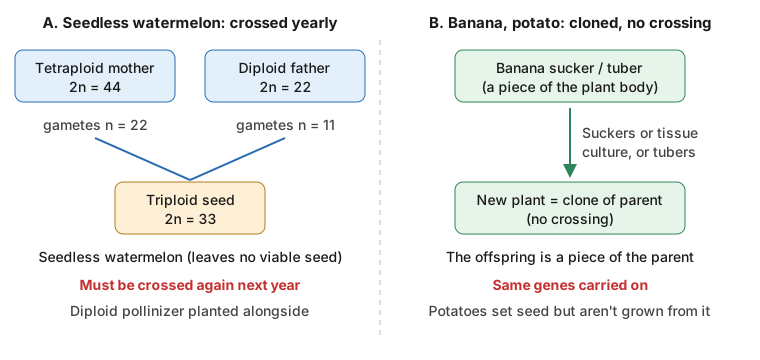
Step 2: Seedless watermelon really is “cross the parents, eat the offspring”
The mechanism starts with counting chromosomes. An ordinary watermelon is diploid (two sets of chromosomes), with 22 per cell.[6] Treat it with colchicine, a chemical that stops chromosomes from separating during cell division, and you get a tetraploid (four sets) with 44.[6] Cross that tetraploid as the mother with an ordinary diploid as the father, and the seed gets chromosomes from the mother’s egg and from the father’s pollen:
The result is a triploid seed with 33 chromosomes.[6] A triploid cannot divide its chromosomes evenly during meiosis, so it fails to make normal reproductive cells and leaves no mature seed.[7] The method was reported in 1951 in the Proceedings of the American Society for Horticultural Science by Hitoshi Kihara of Japan, and the patent literature describes the triploid watermelon as an F1 hybrid of a tetraploid female and a diploid male, citing that paper.[7][8]
So on the watermelon, your friend’s guess is correct. The parents are crossed, and the triploid offspring is only ever eaten. Because it cannot set mature seed, next year’s seed must again come from crossing a tetraploid mother with a diploid father. That cross happens in a seed company’s production field, and farmers buy new seed every season.
There is one more wrinkle. A triploid plant makes essentially no viable pollen of its own, and its flowers still need pollen from a diploid watermelon to set fruit. The patent literature states that sufficient viable pollen from a diploid pollinizer is essential for a triploid female flower to set fruit.[7] A commercial growing guide recommends interplanting diploids at a ratio of at least one diploid plant per three triploids.[9] In other words, every seedless watermelon field has seeded watermelons growing in it.
What about the pale flecks you sometimes see in the flesh? The University of Florida’s extension service (UF/IFAS) explains that seedless watermelons do form seed traces, but these are small, soft, white, edible seed coats that you eat along with the flesh.[6] The grower guide calls them thin, edible white ovules, and adds that stressed plants can occasionally produce an ordinary hard black seed.[9] So “seedless” means “no mature seed usable for propagation,” not “no seed structure at all.”
Step 3: Bananas skip the cross entirely
Bananas play by different rules. The supermarket banana (the Cavendish) is a triploid (AAA) and, like seedless watermelon, cannot form normal reproductive cells, so it is sterile.[10] The decisive difference is that a banana sets fruit without pollination (parthenocarpy), so it never needed seeds to produce a crop, and it was never propagated by crossing in the first place. The abstract of the 2012 Nature banana genome paper summarizes it this way: cultivated bananas were selected as diploid and triploid seedless hybrids and spread widely by vegetative propagation, meaning propagation from a piece of the plant body.[11] The most common planting material is the sucker, a side shoot from the underground stem, and commercial growers also use plantlets grown from tissue culture of the growing tip.[12]
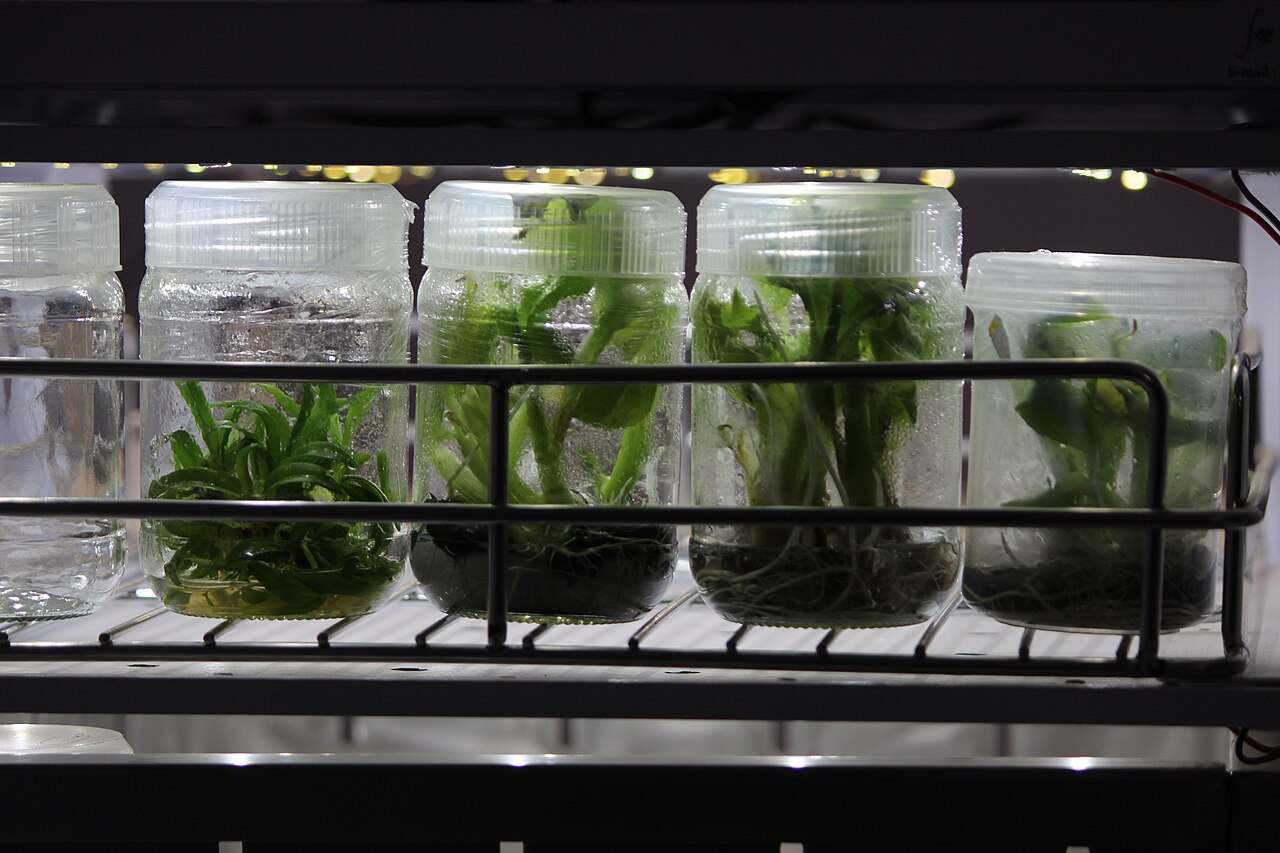

So for bananas the answer to “cross the parents and make the offspring?” is that there is no crossing step. The “offspring” is a piece of the parent. Banana plants from the same stool are, genetically, parts of a single individual. This is where bananas and watermelons part ways most sharply: watermelon makes a new triploid by crossing every time, while banana keeps cutting and replanting one already-selected individual.
Step 4: Potatoes and apples have seeds and ignore them
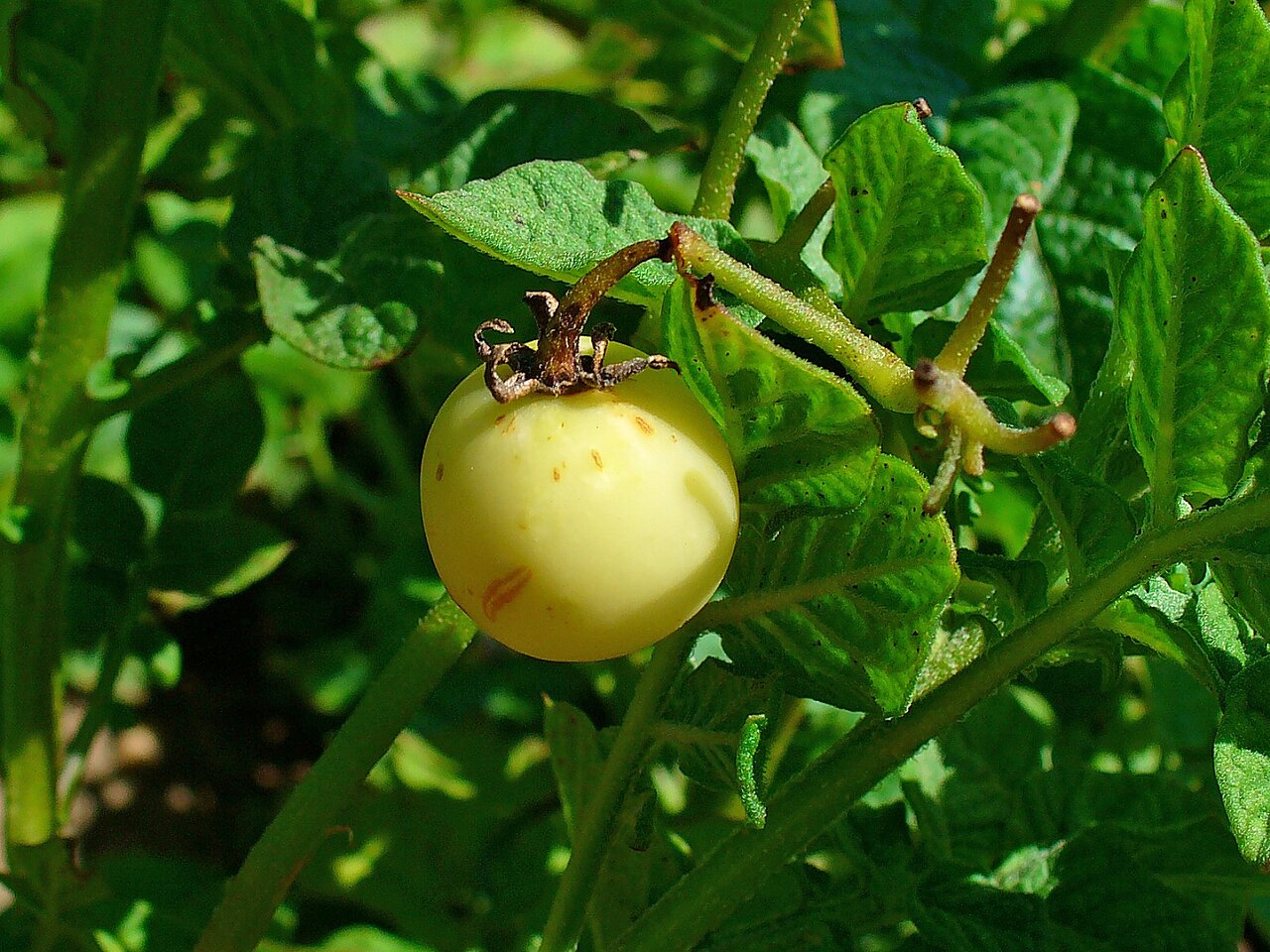
Potato is an interesting middle case. Potato plants flower, and they set fruit and seed. Growers still don’t plant seeds. The cultivated potato is a heterozygous autotetraploid (), meaning each gene typically comes in several different versions, and it has traditionally been grown from tubers.[13] According to the breeding literature, true potato seed progeny from existing cultivars, or from crosses between them, is extremely heterogeneous, with most traits all over the place.[13] So growers cut and plant the tuber (the potato you actually eat), which copies a plant that already turned out well. In plant breeding circles, the potato is classed as a tetraploid crop that is maintained by asexual propagation.[14]

Apples work on the same logic. An apple has perfectly good seeds, but because the tree is heterozygous, a tree grown from a seed will not bear fruit like its mother. That is why, as University of Illinois Extension explains, named apple cultivars must be cloned by grafting rather than grown from seed.[15] Having seeds and reproducing by seed are two separate things.
Counterpoint
At this point you might say: “So the rumor that all bananas are identical is true?” It is partly true, and the scope matters.
What holds up. The UN Food and Agriculture Organization (FAO) states that the Cavendish is the most widely traded variety and accounts for “just under half” of world production.[16] The abstract of the Nature paper likewise says that half of current production relies on somaclonal variants of a single triploid genotype.[11] The risk of that single-clone structure has already played out. In the 1950s, Panama disease (a fungal wilt) wrecked the export variety ‘Gros Michel.’ Export companies began switching to the resistant Cavendish in the late 1950s, and by about 1960 Gros Michel had largely vanished from the trade.[17]
What doesn’t. First, extending the claim to “bananas” as a whole is wrong. The figure above is “just under half,” and other varieties make up the rest.[16] Second, even within the Cavendish group, plants are not perfectly identical. Small mutations accumulate over repeated rounds of tissue culture and sucker propagation, and the useful ones are selected. A Taiwanese research institute selected GCTCV-218 (trade name ‘Formosana’), a somaclonal variant from the Cavendish-type ‘Pei Chiao.’ In field trials, incidence of TR4 (the newer strain of the wilt now threatening the Cavendish) was 4.3% and 4.1%, against 25.5% and 29.6% for the control cultivar. The same source also reports a three-year trial in Australia’s Northern Territory in which it proved as vulnerable as the Cavendish cultivar ‘Williams,’ so it is not a cure-all.[18]
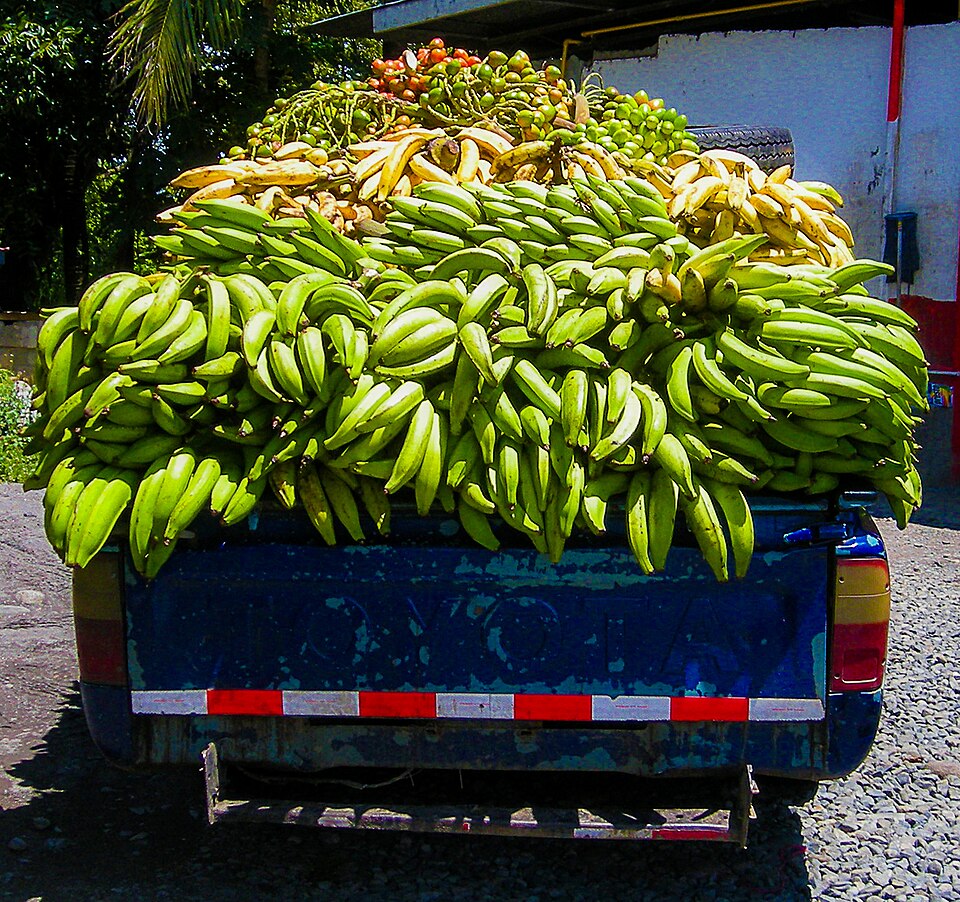

The accurate version: “Export-grade Cavendish bananas are, to a first approximation, descendants of one clone” is nearly right. “All bananas are genetically the same” is not.
Fact
A seedless watermelon is not a GMO. It is a triploid ( chromosomes) bred by crossing a tetraploid with a diploid. The GMO definitions in the US rule, the EU directive (which names polyploidy induction as outside genetic modification), the Cartagena Protocol and Korea’s LMO Act all turn on inserting or recombining foreign nucleic acid or on cell fusion beyond the family. Polyploid breeding and vegetative propagation appear on none of those lists. And the intuition behind the original question is right for watermelon only: watermelon is crossed every year and its offspring is only eaten, while banana and potato involve no crossing at all, because the offspring is a piece of the parent.
The “somebody must have intervened” instinct was right about the intervention. It just wasn’t a gene-editing tool. It was a pollen brush used every season, or, for bananas and potatoes, a pair of shears. Watermelon is the crop where you buy new seed every year, while potatoes and apples are crops that grow seeds and then get planted from a cutting or a tuber anyway. How much a crop depends on seed has little to do with whether the fruit contains any.
There is also a twist for the “is any of this a GMO?” question. Genetically engineered bananas and potatoes do exist. Australia’s Office of the Gene Technology Regulator (OGTR) licensed commercial release of QCAV-4, Queensland University of Technology’s TR4-resistant banana (DIR 199),[19] and Food Standards Australia New Zealand (FSANZ) approved food from that banana in 2024.[20] The US Department of Agriculture’s Animal and Plant Health Inspection Service (APHIS) determined in November 2014 that ten lines of J.R. Simplot’s Innate potato were no longer regulated articles.[21] The purposes were Panama disease (TR4) resistance for the banana, and low acrylamide potential and reduced black spot bruise for the potato. Neither has anything to do with being seedless.
A related myth is worth a line. The seedless watermelon is often credited to Woo Jang-choon, a celebrated Korean agricultural scientist. A 2007 article in the Korean newspaper Hankyoyuk Shinmun (Korea Education News) lays out the actual sequence: Kihara in Japan had already succeeded in growing it in 1943, and Woo grew it in Korea in 1952, where his role was to show farmers the breeding technique.[22]
So the seedless watermelon, the fruit people suspect, turns out to be an old-fashioned hybrid. The banana and the potato, the crops that really do have genetically engineered versions, mostly escape the suspicion.
References
[1]: 7 CFR 66.1 (Definitions: bioengineered food), U.S. Agricultural Marketing Service, https://www.law.cornell.edu/cfr/text/7/66.1
[2]: European Union, Directive 2001/18/EC on the deliberate release into the environment of genetically modified organisms, Article 3(1), EUR-Lex, https://eur-lex.europa.eu/legal-content/EN/TXT/?uri=CELEX:32001L0018 (text comparison: https://www.legislation.gov.uk/eudr/2001/18/article/3)
[3]: European Union, Directive 2001/18/EC, Annex I A Part 2 (polyploidy induction) and Annex I B (mutagenesis; cell fusion of plant cells of organisms that can exchange genetic material through traditional breeding methods), EUR-Lex, https://eur-lex.europa.eu/legal-content/EN/TXT/?uri=CELEX:32001L0018 (text comparison: https://www.legislation.gov.uk/eudr/2001/18/annexes)
[4]: Secretariat of the Convention on Biological Diversity, “Cartagena Protocol on Biosafety to the Convention on Biological Diversity”, Article 3 (Use of terms) (g)(h)(i), https://www.cbd.int/biosafety/articles.shtml?a=cpb-03
[5]: Act on Transboundary Movement, etc. of Living Modified Organisms (유전자변형생물체의 국가간 이동 등에 관한 법률), Article 2 (Definitions) item 2 (a)-(b) (version in force 1 Oct 2025), Korea Ministry of Government Legislation, https://www.law.go.kr/법령/유전자변형생물체의국가간이동등에관한법률
[6]: Stephens, J. M. (1994, reviewed 2003), “Watermelon, Seedless — Citrullus lanatus (Thunb.) Mansf.”, UF/IFAS Extension HS685/MV152, https://doi.org/10.32473/edis-MV152-1994
[7]: “Method for producing triploid, seedless watermelon”, US Patent 7,071,374, background section, https://patents.google.com/patent/US7071374B2/en
[8]: Kihara, H. (1951), “Triploid watermelons”, Proceedings of the American Society for Horticultural Science 58: 217-230. (Bibliographic details as cited in US Patent 7,071,374.)
[9]: Johnny’s Selected Seeds, “Triploid Watermelon” (growing guide, 2016), https://www.johnnyseeds.com/on/demandware.static/-/Library-Sites-JSSSharedLibrary/default/dw05d5992b/assets/information/watermelon-triploid-seedless-production.pdf
[10]: Huang, H.-R. et al. (2023), “Telomere-to-telomere haplotype-resolved reference genome reveals subgenome divergence and disease resistance in triploid Cavendish banana”, Horticulture Research 10: uhad153, https://doi.org/10.1093/hr/uhad153
[11]: D’Hont, A. et al. (2012), “The banana (Musa acuminata) genome and the evolution of monocotyledonous plants”, Nature 488: 213-217, https://doi.org/10.1038/nature11241
[12]: Balerdi, C. F. and Crane, J. H., “Banana Growing in the Florida Home Landscape”, UF/IFAS Extension (Propagation section), https://edis.ifas.ufl.edu/publication/MG040
[13]: Jongedijk, E. (1991), “Desynapsis and FDR 2N-megaspore formation in diploid potato: potentials and limitations for breeding and for the induction of diplosporic apomixis” (abstract: cultivated potato is a heterozygous autotetraploid, 2n=4x=48; heterogeneity of true potato seed progeny), FAO AGRIS, https://agris.fao.org/search/ar/records/64746aa0bf943c8c797ffa05
[14]: University of Wisconsin-Madison Potato Breeding and Genetics, “Enabling Molecular Breeding” (potato is an autotetraploid, asexually propagated crop), https://potatobreeding.cals.wisc.edu/research-2
[15]: University of Illinois Extension, “Grafting: An Important, Age-Old Skill for Aspiring Orchardists”, 14 Apr 2026, https://extension.illinois.edu/blogs/flowers-fruits-and-frass/2026-04-14-grafting-important-age-old-skill-aspiring-orchardists
[16]: FAO, “Bananas” (Commodities overview, Markets and Trade), https://www.fao.org/markets-and-trade/commodities-overview/bananas-tropical-fruits/bananas/9/en
[17]: Soluri, J. (2002), “Accounting for Taste: Export Bananas, Mass Markets, and Panama Disease”, Environmental History 7(3): 386-410. Cited via JSTOR Daily, “The Beloved, Bedeviled Banana”, 2 Sep 2019, https://daily.jstor.org/the-beloved-bedeviled-banana
[18]: ProMusa, “GCTCV-218”, https://promusa.org/GCTCV-218
[19]: Office of the Gene Technology Regulator (Australia), “DIR 199 - Commercial release of GM banana (QCAV-4)”, https://www.ogtr.gov.au/gmo-dealings/dealings-involving-intentional-release/dir-199
[20]: Food Standards Australia New Zealand, “A1274 - Food derived from disease-resistant banana line QCAV-4”, published 29 Apr 2024, https://www.foodstandards.gov.au/food-standards-code/applications/A1274-Food-derived-from-disease-resistant-banana-line-QCAV-4
[21]: USDA APHIS, J.R. Simplot Co.; Determination of Nonregulated Status of Potato Genetically Engineered for Low Acrylamide Potential and Reduced Black Spot Bruise, 79 Federal Register 66688 (10 Nov 2014), https://www.federalregister.gov/d/2014-26593
[22]: Hankyoyuk Shinmun (Korea Education News), “'씨 없는 수박’은 우장춘의 발명품이 아니다” (“The seedless watermelon is not Woo Jang-choon’s invention”), 23 Jul 2007, https://hangyo.com/mobile/article.html?no=55186