You’ve probably read the back of an instant noodle pack at some point. Between the salt, the sugar, and the dried garlic, one line tends to snag the eye: “Antioxidant (mixed tocopherols).” Some brands’ labels list a synthetic version instead — TBHQ, a name that sounds more like a chemistry-class flashback than a food ingredient (more on what it’s actually doing there below). You grew up hearing that instant noodles are “full of preservatives” — so you scan the label for the word “preservative.” It isn’t there. What’s there instead is “antioxidant,” and a quiet suspicion starts to form: maybe that’s just a preservative wearing a nicer name tag.
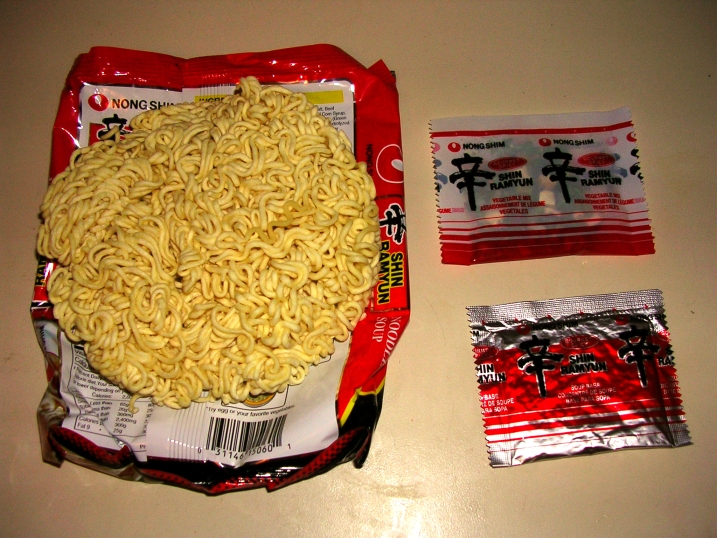

The suspicion isn’t unreasonable. A sealed pack of instant noodles can sit at room temperature for months. Leave it in a hot car trunk over a summer weekend and it comes out fine. That kind of staying power feels like it should require some serious chemical firepower — which is presumably why “instant noodles are basically preservative soup” is a piece of folk wisdom repeated from Seoul to Los Angeles. Is it actually true?
QUESTION
What’s really keeping instant noodles from spoiling at room temperature for months at a stretch? And is the “antioxidant” printed on the ingredient label just another word for “preservative”?
Answering that means separating two questions that tend to get tangled together. One is the actual mechanism that keeps the noodles from going bad. The other is whether instant noodles actually contain a preservative — an additive whose specific job is suppressing microbial growth — in the first place. Conflate the two, and “antioxidant” starts to sound like a euphemism for “preservative.” It isn’t, and the reason why turns out to be more interesting than a simple no.
CHECK
From wet dough to a bone-dry block — what frying actually does
Instant noodle brands everywhere rely on the same two-step trick, whatever country’s supermarket you’re standing in: steam a wheat dough, then flash-fry it in hot oil. It’s this step, not any single country’s recipe, that does the real preservation work.
International food regulators have formalized just how dry that frying step needs to leave things. The Codex Alimentarius Commission — the joint FAO/WHO body that sets global food standards — caps the moisture content of the finished noodle block in its Standard for Instant Noodles (CXS 249-2006) at a maximum of 10% for fried noodles and 14% for non-fried, air-dried varieties.[1]
What that frying step looks like on an actual production line: Samyang Foods, one of Korea’s noodle makers, states in its public FAQ that its steaming-and-frying stage runs at 150°C (302°F).[2] That heat flash-evaporates the water inside the dough almost instantly, leaving behind the familiar wavy, porous (riddled with tiny air pockets) structure. Nongshim, another Korean producer, says it manages the moisture of both the finished noodle block and the powder seasoning down to 4–6%[3] — well under the Codex ceiling.
That figure isn’t just marketing copy; the way it’s measured is standardized too. The Codex method calls for baking a sample at 105°C for 2 hours (fried noodles) or 4 hours (non-fried), then calculating the moisture percentage from the weight lost.[1] An interlaboratory study published in the Journal of AOAC International tested how consistently different labs could reproduce this method and found it held up.[4] In other words, “instant noodles are bone-dry” isn’t a vibe — it’s a defined, measurable spec that regulators, manufacturers, and independent labs all point to.
What matters to a microbe isn’t how much water is there — it’s how much of it they can actually use
Here’s where it gets easy to mix things up. “Moisture content” (the percentage figure above) and “water activity” — the measure microbiologists actually care about, abbreviated Aw — are not the same scale. A food-safety fact sheet from Kansas State University’s Research and Extension service draws the line clearly: “Moisture content measures the total amount of water present in a food, whereas water activity measures the amount of free water available for microorganisms to use.”[5]
Water activity is defined as the vapor pressure a food gives off at a given temperature, divided by the vapor pressure pure water gives off at that same temperature:
Here is the food’s vapor pressure and is that of pure water at the same temperature — a scale from 0 to 1, where pure water sits at and bone-dry material approaches . When water molecules bind tightly to salt or sugar, a food can still contain plenty of water by weight (high moisture content) while having very little of it left “free” for microbes to draw on — so Aw drops even when moisture doesn’t. Two foods with identical moisture percentages can have very different Aw values, and it’s Aw, not moisture content, that decides whether something can grow.
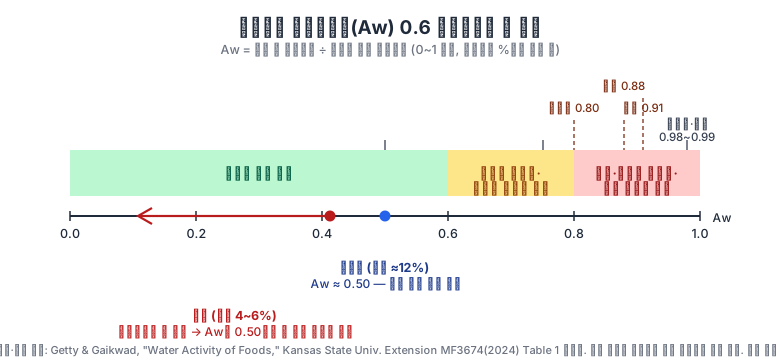
Different microorganisms have different lower limits for how dry an environment they can tolerate. According to the K-State table, at Aw 0.91 and above, many common foodborne pathogens — Salmonella among them — can multiply. Various yeasts persist down to about 0.87. Between 0.80 and 0.87, most molds are still viable, along with Staphylococcus aureus, a bacterium unusually tolerant of low water activity. Push lower still, into the 0.65–0.80 range, and only drought-tolerant (xerophilic) molds and salt/sugar-tolerant (osmophilic) yeasts survive. Below roughly 0.60, nothing grows at all.[5]
| Water activity (Aw) | What can still grow |
|---|---|
| ≥ 0.91 | Many common foodborne bacteria (e.g., Salmonella) |
| 0.87 – 0.91 | Various yeasts |
| 0.80 – 0.87 | Most molds, plus unusually hardy Staphylococcus aureus |
| 0.65 – 0.80 | Only xerophilic molds and osmophilic yeasts |
| < 0.60 | Nothing — microbial growth stops entirely |
Thresholds from the K-State Research and Extension fact sheet.[5]
Where instant noodles land on that scale
Now to put the two pieces together. Moisture content (instant noodles: 4–6%) and the Aw growth thresholds (nothing grows below 0.60) are measured on different scales, so they can’t be equated directly. But a real-food example from the same K-State data lets us gauge the relationship: pasta, at roughly 12% moisture, already sits at an Aw of about 0.50 — squarely inside the “nothing grows” zone on the chart above.[5] Instant noodles run drier than that, at 4–6% moisture. Given that both are dried wheat-based products, it’s reasonable to expect instant noodles land at an Aw meaningfully lower than pasta’s 0.50.
That lines up with what Nongshim itself says: “microorganisms need the moisture content of the material itself to be roughly 12% or higher to survive.”[3] That 12% figure lands almost exactly where pasta crosses into Aw 0.50 — already in no-growth territory. Instant noodles, at 4–6%, sit well under that line. It’s worth being explicit that this investigation did not turn up a published study measuring the Aw of actual instant noodles directly. But stacking the moisture-to-Aw relationship against the manufacturer’s own 12% threshold, the conclusion that “instant noodles are too dry for microbes to survive” isn’t a leap — it’s an inference several independent data points converge on.
So is there an actual preservative in there?
Being unnecessary in theory and being absent in practice are two different claims. On this point, manufacturers and press reporting line up consistently: no preservative is added. Nongshim’s noodle research institute told a Korean business outlet that “most of the moisture is evaporated during the frying and drying stages of production,” which is precisely why a preservative isn’t needed — spelling out that “microorganisms only develop once a material’s own moisture content reaches roughly 12% or higher, and instant noodles keep that figure to 4–6%, so microbes can’t get a foothold.”[6] Samyang Foods’ own FAQ page states it plainly: “During manufacturing, the steaming and frying process (150°C) provides sufficient sterilization, and the product’s moisture content is kept under 10%, so there’s no need to use a preservative to prevent spoilage.”[2] Industry insiders have gone so far as to joke that if you don’t puncture the bag, an unopened pack’s shelf life is basically unlimited — that’s how confident the category is about staying stable without one.[7]
A caveat is worth flagging here: these statements come from manufacturer FAQs, official explainers, and press interviews, not from an independent lab assay cross-checking the actual printed ingredient list of individual products against manufacturer claims — that step falls outside what this investigation could complete. So “instant noodles don’t contain preservatives like sorbic acid or benzoic acid” is a claim resting on consistent manufacturer statements and press reporting, not on independent product testing. Worth noting too: the liquid seasoning packet, which holds far more water than the noodle block itself, takes a different approach — salt, sugar, and organic acids adjust its salinity, sweetness, and acidity, backed by heat treatment, to keep microbes from taking hold.[3] That’s still not a chemical preservative being added; it’s the same underlying principle as the noodles themselves — make the environment itself uninhabitable rather than poisoning anything that tries to grow there.
So what is “antioxidant” doing on the label, then?
Which brings us back to where this started. A preservative’s job is stopping microbial spoilage. But microbes aren’t the only way food goes bad. A fried noodle block retains a meaningful amount of the oil it was cooked in, and that oil reacts slowly with oxygen in the air, degrading in smell and flavor — a process called rancidity. Rancidity has nothing to do with microorganisms; it’s a purely chemical reaction (oxidation). Antioxidants — mixed tocopherols (vitamin E), green tea extract, or synthetic compounds like TBHQ — exist to slow exactly that oxidation. They do a fundamentally different job than suppressing microbial growth.[3]
This isn’t marketing spin painting over a single category — it’s written directly into international food regulation. The Codex Standard for Instant Noodles lists approved additives by function, and it keeps these two uses in entirely separate columns.
| Category | Codex INS range | Examples | Maximum level |
|---|---|---|---|
| Preservatives | INS 200–203 | Sorbic acid and its salts (sodium, potassium, calcium sorbate) | 2,000 mg/kg, as sorbic acid |
| Antioxidants | INS 300–321 | Ascorbic acid; mixed tocopherols; propyl gallate; BHA, BHT, TBHQ | GMP (no fixed limit) for ascorbic acid; 200 mg/kg for most others; 500 mg/kg for combined ascorbyl esters |
Source: Codex Alimentarius, Standard for Instant Noodles (CXS 249-2006), §4.[8]
Not just the names differ — the entire approved-substance list and the method for setting maximum levels are different for each category. South Korea’s Ministry of Food and Drug Safety is reported to run its own domestic Standards and Specifications for Food Additives on the same functional-category logic, placing preservatives and antioxidants under separate use classifications there as well.[9] When a label says only “antioxidant,” that isn’t a preservative operating under an alias. It’s a different substance that was never in the preservative drawer to begin with.
To sum up the mechanism: instant noodles resist spoilage not because of a preservative, but because frying drives moisture down far enough that microbes have nothing to work with. Manufacturer statements consistently indicate no preservative is actually added. And “antioxidant,” as it appears on the label, isn’t a rebranded preservative — it’s a distinct additive category, with its own name, its own approved substances, and its own permitted levels, dedicated to slowing oil rancidity rather than stopping microbial growth.
FACT
Instant noodles don’t stay shelf-stable for months because of a preservative — they stay shelf-stable because they’re extremely dry. The Codex Standard for Instant Noodles caps moisture at 10% for fried noodles and 14% for non-fried varieties,[1] and Korean manufacturers report managing their own products to an even lower 4–6%.[3] Given that pasta, at 12% moisture, already sits at an Aw of 0.50 — a level where no microorganism can grow[5] — instant noodles, drier still, are almost certainly well below that. The “antioxidant” printed on the label isn’t a euphemism for preservative; it’s an entirely separate additive category that slows the frying oil’s reaction with oxygen, not microbial growth.[8] The eyes squinting at the ingredient list looking for a hidden preservative end up missing something else entirely: not an absent preservative, but the actual reason a different additive is there.
One thing deserves to be said for balance. The absence of preservatives doesn’t make instant noodles a health food. A single 120 g pack of Shin Ramyun — sold in supermarkets from Seoul to Los Angeles to London, and one of the most globally recognized instant noodle brands — carries about 1,790 mg of sodium by the manufacturer’s own label,[10] which sits close to the World Health Organization’s recommended ceiling of under 2,000 mg of sodium per day for adults (equivalent to under 5 g of salt).[11] That’s not an outlier for the category, either: a separate Korean market survey put the average sodium content of soup-style instant noodles at around 1,693 mg per serving.[12] This article is a fact-check of what is and isn’t actually in the ingredient list — not health advice on how much instant noodle you should eat. Still, it’s worth being clear that “no preservatives, so it’s fine” and “so it’s fine to drink the whole broth” are answers to two different questions. That a preservative-free noodle isn’t a sodium-free noodle is obvious once you say it out loud — and easy to forget anyway.
References
[1]: Codex Alimentarius Commission, “Standard for Instant Noodles” (CXS 249-2006), §3.2.3(a) Analytical Requirement for Noodle Block — Moisture Content: Maximum 10% (fried noodles) / 14% (non-fried noodles). FAO/WHO. https://www.fao.org/input/download/standards/10658/CXS_249e.pdf
[2]: Samyang Foods official FAQ, “Is it true that instant noodles contain preservatives?” — “During manufacturing, the steaming and frying process (150°C) provides sufficient sterilization, and the product’s moisture content is kept under 10%, so there’s no need to use a preservative to prevent spoilage.” https://www.samyangfoods.com/kor/community/faq/list.do
[3]: Nongshim, “Ramyunpedia — How can instant noodles keep for so long without preservatives?” https://www.nongshim.com/promotion/ramyun_pedia/view?groupCode=004&groupId=5&page=3
[4]: A. Hakoda, H. Kasama, K. Sakaida, T. Suzuki & A. Yasui, “Determination of the Moisture Content of Instant Noodles: Interlaboratory Study,” Journal of AOAC International, Vol. 89, No. 6 (2006), pp. 1585-1590. https://academic.oup.com/jaoac/article/89/6/1585/5657787
[5]: Kelly Getty & Rashmi Gaikwad, “Water Activity of Foods” (MF3674), Kansas State University Research and Extension, September 2024, Table 1 (original source: Fontana, A. J., “Understanding the importance of water activity in food,” 2000). https://bookstore.ksre.ksu.edu/download/water-activity-of-foods_MF3674
[6]: Asia Economy (아시아경제), “The ‘unjust accusations’ you’ve misunderstood about instant noodles” (2020.10.8). https://www.asiae.co.kr/article/2020100808030669056
[7]: E-News Today (이뉴스투데이), “[Rumor check] Do instant noodles with a 6-month shelf life contain preservatives?” https://www.enewstoday.co.kr/news/articleView.html?idxno=1313179
[8]: Codex Alimentarius Commission, “Standard for Instant Noodles” (CXS 249-2006), §4 Food Additives — Preservatives (INS 200-203, sorbates, maximum 2,000 mg/kg as sorbic acid) and Antioxidants (INS 300-321: ascorbic acid at GMP; mixed tocopherols/propyl gallate/BHA/BHT/TBHQ at 200 mg/kg; combined ascorbyl esters at 500 mg/kg) — lists and permitted levels. FAO/WHO. https://www.fao.org/input/download/standards/10658/CXS_249e.pdf
[9]: Ministry of Food and Drug Safety (South Korea), Notice No. 2024-56, “Standards and Specifications for Food Additives” (revised 2024.10.2). https://www.mfds.go.kr/brd/m_211/view.do?seq=14851
[10]: Nongshim Shin Ramyun (120 g) nutrition label, manufacturer-declared figure — 1,790 mg sodium per pack. Cross-checked against the Pillyze nutrition information database. The declared sodium figure has changed over time under the manufacturer’s own reduction policy (approx. 1,930 mg around 2007-2012 → 1,790 mg currently declared). https://www.pillyze.com/foods/DgpxhgOUGeNEbLWHb_x1yA==/신라면
[11]: World Health Organization, “Sodium reduction,” Fact sheet. https://www.who.int/news-room/fact-sheets/detail/sodium-reduction
[12]: Daehan Foodservice News (대한급식신문), “Among instant noodles, Shin Ramyun ranks #1 in sodium!” — comparative survey putting average sodium in soup-style instant noodles at 1,693 mg. https://www.fsnews.co.kr/news/articleView.html?idxno=31022
[13]: Wikimedia Commons, “Shinramyun contents.jpg” (Public Domain, uploaded by Pravit726). https://commons.wikimedia.org/wiki/File:Shinramyun_contents.jpg